'This Week' Transcript 11-22-26: Director of National Intelligence Jay Clayton & former Chicago Mayor Rahm Emanuel
This is a rush transcript of "This Week" airing Sunday, November 22.
A rush transcript of "This Week with George Stephanopoulos" airing on Sunday, November 22, 2026 on ABC News is below. This copy may not be in its final form, may be updated and may contain minor transcription errors. For previous show transcripts, visit the "This Week" transcript archive.
(COMMERCIAL BREAK)
JONATHAN KARL, ABC “THIS WEEK” CO-ANCHOR: After a week of anxiety over tech outages, we’re now learning of new cyberattacks at the FBI and another federal government agency. “THIS WEEK” starts right now.
(BEGIN VIDEO CLIP)
KARL: Tech frenzy.
SEN. JOSH HAWLEY (R-MO): If this is all a coincidence, it’s like the greatest coincidence in the history of the world.
KARL: High-profile outages leave the nation rattled and markets plunging, as the administration tries to calm nerves.
J.D. VANCE, VICE PRESIDENT OF THE UNITED STATES: Should we be preparing to build a bunker and to stock up on food and water? And my answer to that is, no.
KARL: And lawmakers demand answers.
REP. DANIEL GOLDMAN (D-NY): Is it your testimony today that the American people should believe that the series and sequence of events over the last week is purely coincidental?
JAY CLAYTON, DIRECTOR OF NATIONAL SECURITY: We have no indication that these events are related.
KARL: This morning, we are joined by America’s highest ranking intelligence official, Jay Clayton.
China, Russia and Trump.
DONALD TRUMP, PRESIDENT OF THE UNITED STATES: There was great, great electricity. Unbelievable.
KARL: As President Trump touts his meeting with the leaders of China and Russia, backlash at home.
SEN. CHUCK SCHUMER (D-NY): It’s a betrayal of the United States.
KARL: What did the president accomplish? We’re joined by former White House chief of staff, ambassador to Japan, and former mayor of Chicago, Rahm Emanuel.
And Elon’s 180.
ELON MUSK, FOUNDER, TESLA: I’m not MAGA. Well, at least I’m not like -- I'm not sure what MAGA means.
KARL: Our roundtable on Elon Musk’s sudden reversal, as Democrats prepare to take over Congress.
(END VIDEO CLIP)
ANNOUNCER: From ABC News it’s “THIS WEEK.” Here now, Jonathan Karl.
KARL: Good morning. Welcome to “THIS WEEK.”
As we come on the air this morning, we are learning more about apparent cyberattacks on two major government agencies, the FBI and the Department of Agriculture. Unlike the major tech outages that we’ve seen over the past ten days, sources tell ABC News that these are the work of bad actors breaking into government systems, something that will no doubt add to the anxiety that many of us are feeling about the systems we rely on in our everyday lives. The systems that power our economy.
Government officials, from the president to the secretary of state, to the director of national intelligence have told us that all those tech outages were caused by technical glitches, not cyberattacks. That may be true. It’s also true that many Americans just don’t buy it.
Regardless, the vulnerabilities have heightened concerns that bad actors can use the power of artificial intelligence to do significantly more damage. And this week, Anthropic, a company whose CEO has warned that his technology has the potential to destroy all of humanity, went public.
The stock market itself had a brutal week. The Dow and the Nasdaq, the worst week since the Covid pandemic forced the shutdown of much of the country in March of 2020. Some of the anxiety is playing out on the shelves of stores like Costco and Walmart, which have seen a surge in sales of generators, water and other basic supplies you would need in an emergency. While much of this was happening here at home, President Trump traveled to Asia, where he enjoyed a lavish welcome in China and met with the world’s two most powerful dictators. His message to fellow Americans, relax, things will be OK.
(BEGIN VIDEOTAPE)
KARL (voice over): An imperial welcome for President Trump in China. President Xi on the red carpet greeting Air Force One. Young performers waving pom poms and flags. The People’s Liberation Army Band. Chinese soldiers marching in formation. And from Xi himself, a hug. Trump called the greeting itself a big win for America.
It was also the third time this year that President Trump has met with China’s president. America’s most powerful adversary, and a man Trump calls his friend.
And Trump also met with the other dictator he calls a friend, relishing his elaborate three-way meeting with Putin and Xi. The first ever trilateral meeting between the leaders of China, Russia and the United States. A memorable photo-op for sure, the Chinese president presiding, but no major accomplishments beyond providing a distraction from the growing anxiety back home.
DONALD TRUMP, PRESIDENT OF THE UNITED STATES: Tell them to relax. Everything’s good.
KARL (voice over): A nation on edge over artificial intelligence. A seemingly endless onslaught of major tech outages. And a tanking stock market.
UNIDENTIFIED MALE: Now to the major sell-off in A.I. stocks.
KARL (voice over): This week, the biggest IPO in history. Anthropic valued momentarily at $2 trillion. The excitement quickly gave way to anxiety. The worst week for the Dow and the Nasdaq since the Covid pandemic shut the country down more than six years ago, hammering the 401(k)s of millions of Americans.
Investor fear on Wall Street mirrored growing apprehension on main street. Tech outages seemingly everywhere, messing with air travel, banking, email and even the nation’s most secretive spy agency. The Trump administration tried to quell those concerns, saying none of it appeared to be the work of a nefarious hacker.
MARCO RUBIO, SECRETARY OF STATE: We have absolutely no reason to believe, we have no evidence, no indications of any kind that these instances -- that these incidents are related to each other.
JAY CLAYTON, DIRECTOR OF NATIONAL SECURITY: They are not a coordinated or state sponsored attack.
KARL (voice over): But that was before the cyberattacks on the FBI and the Department of Agriculture late last week. And one tech leader is warning that cyberattackers will soon overwhelm those trying to defend against them.
PALMER LUCKEY, ANDURIL INDUSTRIES FOUNDER: And as of right now, there’s a mismatch between the attackers, who are very fast moving and using technology, and old, outdated systems that are not able to adopt technology as quickly as it is developed. And I think it’s -- people are going to have to pick up the pace. It’s time to start running.
(END VIDEOTAPE)
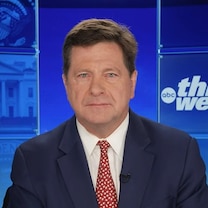
KARL: And I'm joined now by America's top-ranked intelligence official, director of national intelligence, Jay Clayton.
Director Clayton, thank you for being with us here this morning.
Let me start right with the -- these reports of a recent hack to the FBI’s criminal database. What can you tell us about that?
JAY CLAYTON, DIRECTOR OF NATIONAL SECURITY: Jon, let me -- let me put it in context. And there’s been a lot of discussion this week about our cybersecurity, our digital infrastructure.
Cyber probing, cyber incidents, they have been part of the American economy, part of the American life for a long time. And what we’re hearing about the FBI, and what I've -- what I've talked to them about is they have an incident. They’re dealing with it in the ordinary course.
Let me -- let me give you some data here, Jon. In 2020, there were roughly 750,000 cyber incidents reported to the FBI. That’s now up to over a million cyber incidents. And what we’re seeing, though, here, and I want the American people to know this, is we have a step change in technology that we’re facing with superintelligence and computing power that is expanding exponentially and we have a dated digital infrastructure. The need to improve our digital infrastructure is clear. And that is -- that is the dynamic that we have today.
KARL: So, you don’t see this as a particularly alarming attack? This isn’t an attack reported by the FBI. This is an attack on the FBI. But this doesn’t seem like -- do we have any idea who’s behind it?
CLAYTON: Jon, I'm not in a position to get into the specifics right now on that, what I would say is incident. We have highly professional people at the FBI who handle both private sector and public sector incidents like this. And I'm sure we’ll get the answers in due course, just as we’ve gotten the answers to the incidents that happened this past week at the NSA, at Microsoft, at other places.
You know, one of the great things about America, and going into Thanksgiving week I always remind everybody about this, is transparency is key. We gather the facts and then we share them with the American people. And that’s what will happen here.
KARL: And you remain confident that all those other incidents that we’ve seen, beginning with Microsoft, the FAA, J.P. Morgan, all of those other incidents, those were technical glitches. Those were not cyberattacks. But the FBI incident is different. And also, we heard about this Department of Agriculture incident. What can you tell us about that? Do you have any information about who was behind that hack?
CLAYTON: Again, not getting into specifics.
Let me tell you what we know and be very clear with the American people. The incidents that we saw during the course of this week, we know that they were not coordinated and that they were not state sponsored. These were -- these were what I would say is delays, outages and the like resulting from upgrades to systems which are absolutely necessary going forward. And we’re going to see more of that. And companies and the government, we should all be transparent with the American people that we have dated systems in a highly evolving environment where they need to be upgraded in order to have cybersecurity.
Now, to your point on cyberattacks -- there is an increase, as I mentioned, in cyberattacks. But this is something that we have had for a long time. Many of our companies -- let me -- let me make a great point about America. We have the leading cybersecurity firms in America. And these are large firms. The reason they’re large firms is that this has been an issue that we’ve been dealing with and dealing with on the front foot for a while.
If you look at the leading independent cybersecurity firms in America, they have a market cap, $200 billion, $300 billion. That’s the amount of effort and ingenuity and human capital that we’ve been putting into these things. We are going to lead the world in protecting digital infrastructure, Jon.
KARL: Let me turn to China. Senator Tom Cotton, I'm sure you saw, told “The Wall Street Journal” this week that Commerce Secretary Howard Lutnick repeatedly ignored warnings about A.I. chips being smuggled into China.
He said, “If Howard Lutnick wanted my support, perhaps he should have responded to my many letters warning about the Chinese communist front companies and, more importantly, taking the threats of communist China more seriously.”
Cotton says that the administration, “although they took some steps,” you took some steps, “this week on this issue,” he says, “it’s just a big late, regrettably, and I think we need to catalogue the damage that has already been done.”
So, is Tom Cotton right, there’s been damage that’s been done because of what’s not gone through at Commerce, and how much damage?
CLAYTON: Let’s take this back and frame it for the American people. We have export restrictions on exquisite technology. They are restrictions. They are not bans.
What do we want as the American people? We want to absolutely maintain our leadership in exquisite technology. That means not allowing our adversaries to gain access to that.
However, we also want to lead in technology infrastructure around the world. So that means that less exquisite technology should be available around the globe for this digital infrastructure buildout. The Department of Commerce, the Department of Treasury, they are -- they are in the business of metering that. And I will leave the specifics of that to them.
KARL: I mean, he’s saying quite directly that Howard Lutnick ignored his warnings and did damage to the country’s national security as a result. Is Tom Cotton wrong about that?
CLAYTON: Jon, what I'm going to -- what I'm going to say is, in that context of, we want to lead the globe in the buildout of this infrastructure, but we also want to keep the most exquisite capabilities for America. There is -- there is a debate to be had. And I -- and I support that discussion.
KARL: OK, I don’t hear a direct answer to that, but let me -- let me move to the other related major issue if you can clear something up for me on the Nvidia question, the Nvidia question. Did Alice Huang, the woman who reportedly had an affair with Jensen Huang, did she pass on information or otherwise assist the Chinese communist government?
CLAYTON: Jon, as Attorney General Blanche has made clear, there is an investigation ongoing into her firm and into her. And I'm going to await the outcome of that investigation.
KARL: Can you say with confidence that Nvidia chips were not used to support the Chinese military?
CLAYTON: Oh, Jon, let’s be clear. Nvidia chips are -- they are the jewel. They are the absolute top that everybody wants. That’s why we’re focusing on this.
People will do a lot. They will break the law. There are indictments already involving other companies where people have broken the law to get access to Nvidia chips.
That is -- that is why it is so important for us to lead and for us to understand how we meter access around the world.
KARL: Do you know where Alice Huang is right now?
CLAYTON: Jon, I can’t tell you that. I do not.
KARL: You do not. There are reports that she is in China.
CLAYTON: Oh.
KARL: Let me ask you another question about the president’s recent trip this week to China. He called Vladimir Putin a “friend,” which he’s done before, and then he posted this on Truth Social, a picture of -- with Vladimir Putin saying, “my friend.” And when he was asked about this, this week, he was asked, “he’s your friend. Is he America's friend?” The president said, “I can’t speak to America.”
But let me ask you. You’re the director of National Intelligence. Is Vladimir Putin America's friend?
CLAYTON: That conversation, that picture, historic, historic picture, was in the context of the three nuclear powers, the three main nuclear powers getting together and saying, we cannot have a -- we cannot have a nuclear incident.
That’s -- it’s unbelievable that the three of them got together and had that discussion in what I -- what I would say is, you know, a time in the world where there’s conflict and the like and it should be assuring that you have the three world nuclear powers getting together and saying, we’re not going to go in that direction.
KARL: But my -- but my --
CLAYTON: I think -- I think that any time you have that it’s -- but let me say, in that --
KARL: Yes.
CLAYTON: In that circle -- in that circle of that conversation, using the term “friend” is entirely appropriate.
KARL: So, but my question is, is Vladimir Putin America's friend? Because Trump said he couldn’t answer that question.
CLAYTON: Look, I -- Jon --
KARL: Is he America's friend?
CLAYTON: Jon, is Vladimir Putin America's friend? He is not America's friend in Ukraine. Not at all. Not at all.
KARL: OK. And let me ask you, we -- this week we -- you know, as you know, the -- CISA, the cybersecurity agency, has been without a confirmed leader for almost two years now, but we finally did have a nominee who had a confirmation hearing this week. This is Michael LoSapio. I want to play something from that hearing for you.
(BEGIN VIDEO CLIP)
SEN. RICHARD BLUMENTHAL (D-CT): Was there an attack on the Capitol on January 6, 2021?
MICHAEL LOSAPIO, CISA DIRECTOR NOMINEE: I don’t know.
BLUMENTHAL: You don’t know?
LOSAPIO: I don’t know how you define --
BLUMENTHAL: Really?
LOSAPIO: So, I -- no, I don’t believe it was an attack, no.
BLUMENTHAL: Let me ask you again. I'll give you another chance. January 6, 2021, was the Capitol attacked?
LOSAPIO: No.
BLUMENTHAL: It was not attacked?
LOSAPIO: No, sir.
(END VIDEO CLIP)
KARL: So, Director Clayton, let me just ask you the exact same question, was there an attack on the Capitol on January 6, 2021?
CLAYTON: Jon, I'm not -- I'm not going to relitigate that issue here. I'm moving forward.
KARL: I'm not asking you to relitigate it. I'm just asking you if it happened. That’s all I'm asking you, did it happen?
CLAYTON: Jon, the American people saw what happened that day. It was -- it was a very unfortunate day for America.
In terms of, you know, does everyone who saw that wish it never happened? Absolutely. But I'm not going to get into the political characterizations and the hearings like that.
KARL: I mean doesn’t it concern you that somebody who clearly has a lot of qualifications, somebody nominated for one of the most important jobs right now in terms of protecting the homeland, can’t answer the question the way you just did?
CLAYTON: Jon, I think that you’re looking at soundbites in the context of a hearing. Again, it’s very clear to every American that that was an unfortunate day. A day that we never want to see happen again.
KARL: And clear that the Capitol did, in fact, come under attack, correct?
CLAYTON: Jon, again, I'm not going to -- I'm not going to get into characterizations. There is --
KARL: I mean -- I mean we saw those windows smashed.
CLAYTON: There is no way we would ever want -- we would ever want that to be repeated.
KARL: The police officers, the beatings (ph) --
CLAYTON: We don’t -- we don’t want people hurt. We don’t -- we don’t want violence, Jon. We all condemn violence. We all condemn violence. There is no place for violence in America.
KARL: And the violence was a violent attack on the Capitol, let me just -- to state the obvious, right?
CLAYTON: Jon, there was -- Jon, there -- Jon, there was violence. You can call it what you want. Every American can call it what you want. There was clearly violence. There was clearly imagery --
KARL: An attack.
CLAYTON: Clearly things that we -- there was clearly trespass, there was clearly things that we don’t want to have happen again.
KARL: OK. Director of National Intelligence Jay Clayton, thank you for joining us this morning, sir.
CLAYTON: Jon, thank you.
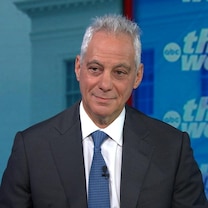
KARL: We are joined now in studio by Rahm Emanuel, a man who has served as White House chief of staff, mayor of Chicago, U.S. ambassador to Japan, and head of the Democratic Congressional Campaign Committee the last time Democrats had a big wave election.
Mayor Emanuel, thank you for joining us.
RAHM EMANUEL, FORMER MAYOR OF CHICAGO: Thanks, Jon.
KARL: So just quickly on that, what is it? I mean, Jay Clayton’s a serious, accomplished individual. And not even he can answer a question that --
EMANUEL: You know the answer. First of all, their party, the Republican Party, is a cult. Ours is a coalition. That was a dear, dear leader statement. It’s self-evident to everybody with the naked eye that what happened on January 6th was not just unfortunate. It was a crime against our democracy. It was a violation of the principle of the peaceful transfer of power. That’s what happened. Even Vice President Pence knew that, which is why he stepped down.
KARL: Well, he knew from personal experience.
EMANUEL: Yes.
KARL: So --
EMANUEL: No, but not just personal. He knew that it was a violation of a principle.
KARL: Yes.
EMANUEL: And, yes, his personal security, but also a principle of our democracy.
KARL: So -- but at the same time in that interview we heard from Director Clayton a very direct answer about Vladimir Putin, he is not our friend in Ukraine.
EMANUEL: Yes. Well, no, he’s not our friend -- well, first of all, that’s not an accurate answer just in Ukraine. He’s not --
KARL: Well, I didn’t say “just,” but, yes.
EMANUEL: OK. He’s not our friend in the Middle East where --
KARL: Iran.
EMANUEL: -- we have lost -- we have lost men and women who executed the commander in chief's national security goal. And we have lost them because of the technology and the information that Russia gave Iran. Third, he's not our friend in the Indo Pacific, where they just buzzed Japan, the long pole of our national security in the Far East. So limiting it to Ukraine and also not just Ukraine, he's not our friend in Europe, given what he's doing on the gray zone attacks.
And also, Jon, let me add, he is now providing technology to China on the submarines where we have a strategic advantage against China. He -- they are building both China, Iran, North Korea with Russia, a most advanced drone that is beating the defenses there. It's not -- the problem here is you have a president who confused his Facebook friend list with our national security.
And that is not just limited to Ukraine. When he does that, it explains to me the director doesn't understand the full depth and breadth of what Russia is trying to do to undermine the United States and our security apparatus.
KARL: Well, you spent a lot of time in the region. You were ambassador to Japan. You know, China. What do you think the answer is to the question he wasn't able to directly answer about how much damage has been done based on the Commerce Department's inability to restrict access to this technology?
EMANUEL: This goes to the core of what's wrong with the Trump administration's foreign policy. We were part and I was part of putting export controls where you had Taiwan, Japan, South Korea, the Dutch and the United States isolate, which is what I call the policy for us, isolate the isolator. China should be isolated. And we had export controls, so it was comprehensive and thorough, which you need to upgrade.
Here we have a case where the United States violated its own export control. And the secretary of Commerce even took it farther, was warned. And this goes to the culture of this administration. I say this jokingly, but I'm serious. Harry Truman had a sign on his desk that said, the buck stops here. The president has the same sign, and he literally means the buck stops here. This is a pay-to-play administration where corruption is their brand and their philosophy.
KARL: All right. We're going to take a quick break. When we come back, we'll have more with Rahm Emanuel and what he sees as the top priorities for the new Democratic majorities in Congress, and maybe a little on his plans for 2028.
We're back in two minutes.
(COMMERCIAL BREAK)
KARL: We're back now with Rahm Emanuel, who gave a speech this week talking about what he believes are the priorities or should be the priorities Democrats should have after the big win in the midterms.
So, and again, you were there when Democrats took over in 2006. You were the head of the campaign committee. And this time around, you have said that this election was a repudiation of the Republicans, not a vindication for Democrats.
How does the Democratic Congress get at that? How should they?
EMANUEL: Both in style and substance, deliver change fast and furious. An ethics package that deals with the corruption that the American people rated number one. As I've said, ban all stock trading, all three branches of government. Ban all prediction market participation, mandatory blind trust, mandatory age and term limit, or call (ph) -- what I call the Jerry Kushner rule, no foreign money while you're in and for two years out of government.
Number two -- and the last time it passed was 2007, Senator Obama, Congressman Rahm Emanuel's ethics reform. Number two, raise the minimum wage $20 by 2030.
Three, reduce and restrict and repeal tariffs increase. All of those would go to affordability, as well as the corruption. And to me, they all pass bipartisan.
So, to all the people that flipped red districts blue, they will be both in style and substance be able to deliver to their voters real change, tangible change and bipartisanship. And I say that because these are red districts you flipped.
Jon, the USS Abraham Lincoln was at sea for 322 days. The kids towards the last months had rancid food, no bathrooms, but they worked.
KARL: Yeah, we covered it.
EMANUEL: Okay. The Congress was in session for only 100 of those 322 days.
KARL: Yeah.
EMANUEL: You're getting full pay, part-time work. Break a sweat.
KARL: So, Hakeem Jeffries is going to be the next speaker.
EMANUEL: Yeah.
KARL: I mean, we saw overwhelmingly voted the leader.
What do you think of the 11 Democrats who voted against him?
EMANUEL: Give me a break. You have a -- step back from all the politics, which I love and you love. You have history being made in Mississippi. And also, Hakeem Jeffries' history. Okay?
You have the number two --
KARL: Black speaker.
EMANUEL: First Black speaker, number two in line for the presidency. And as somebody who was chief of staff to President Obama, that is a statement about America that we should take pride in. You -- and we're a coalition. You're going to tell the most loyal coalition partner, the African-American community, that a moment in history, you're not going to get it? It tells you something that
KARL: So they don't overwhelmingly the DSA --
(CROSSTALK)
EMANUEL: Yeah, overwhelmingly. I mean, as I've said this before, look. You're like the Green Party and the Libertarian Party. I'll see you in November. If you think people want defunding the police, open borders, open prisons, I'll see you in November and we'll see if the American people want it.
But this was history. You should affirm uniformly. And I believe that they literally don't understand the Democratic Party. They're not part of the Democratic Party because we are a coalition. The Black vote is the most significant, most loyal, most dedicated part of the coalition.
So, you voted against Hakeem Jeffries, who made history and earned it when we were in the minority. came along and literally hadn't earned this election. He literally over the years built a majority here that should be affirmed and not only affirm -- it tells me when you vote against him, you don't understand the politics of the Democratic Party.
KARL: It'll be interesting to see how he -- how he treats them. But let me ask you --
EMANUEL: I can guarantee you he's going to give them the Brooklyn love.
(LAUGHTER)
KARL: Let me ask you about --
EMANUEL: He should, at least.
KARL: -- about one of the things you mentioned in your package that they should pursue. One of them is a strict age limit for federal law.
EMANUEL: Yeah.
KARL: Seventy-five years. Thank you for your service, up and out is the way to describe it.
EMANUEL: Yeah.
KARL: I'm sure you --
EMANUEL: Pre-TSA. Get out of here.
KARL: I'm sure you know this, but Senator Chuck Schumer turns 76 tomorrow.
EMANUEL: Yeah.
KARL: You'll send him something?
(CROSSTALK)
EMANUEL: Yeah. I didn't know that, but OK.
KARL: Yeah, OK. It is his birthday. Is it time for him to be up and out?
EMANUEL: Yeah, look, here, I've been very --
KARL: Yeah?
EMANUEL: Yeah. Look, if I was Chuck Schumer --
KARL: Yeah.
EMANUEL: -- what I would say is I'm going to secure the majority. I'm not going to run for majority leader next cycle. And I'm going to make sure other -- the young voices and faces of this party grow. That would take the tension out of this.
KARL: He should serve as majority leader for this next two years?
EMANUEL: Yeah. Just get it over with.
Here's the thing: nobody in November 3rd --
KARL: Yeah.
EMANUEL: -- voted for the Democrats to decide who gets what title and what office. They voted for a minimum-wage increase. They voted to end the political corruption in Washington, power-wash this city.
And I think this is an example where the Democrats should not be involved in this. And my view is, yes. You take a look at Mitch McConnell. You look at the president of the United States. You look at Dianne Feinstein. You look at Ruth Bader Ginsburg.
Hard age or term limits so we don't involve and become a cheap knockoff of the Russian politburo in the worst of the Brezhnev era.
KARL: Can I ask --
EMANUEL: And I -- and I say this: Chuck Schumer is a friend as is Chris Van Hollen, but this is not what people voted for. They voted to get their lives better, not yours.
KARL: Okay but sounds like you want Schumer over Van Hollen. If you were in the Senate, you would be supporting Schumer?
EMANUEL: I'm not a senator. I don’t -- I’m not --
(CROSSTALK)
KARL: Okay. So let me ask you --
EMANUEL: It’s not of interest to me.
KARL: Okay. This power washing of city, let me ask you about all that Trump has literally done to the city.
EMANUEL: Uh-huh.
KARL: We've seen the changes to the Oval Office.
EMANUEL: Uh-huh.
KARL: The ballroom that's going to be built by the time the next president moves in. What does the next Democratic president do? Is that stuff all -- does the ballroom get knocked down? Does the --
EMANUEL: I think we're down, not -- not yet. Look --
(CROSSTALK)
KARL: Not done, yes?
EMANUEL: No, my focus -- look, I said it in the speech in Carnegie Mellon on the economy. I'm interested in classrooms, not ballrooms. OK? I'm interested in --
KARL: What do you do with the things built? What do you do?
EMANUEL: On the ballroom, look -- well, it's not built. It's kind of in process.
KARL: But by the time -- by the time the next president --
EMANUEL: The construction is already done. I think the opening floor should be dedicated to the history of our democracy and what we've built, the good, the bad, the ugly.
KARL: Yeah.
EMANUEL: And so you have a version of what the president's done, which is, I think, it's horrendous, both substantively in style that he did, but dedicate a major portion as you walk in, the guests who walked in, to the democracy of this country.
Second, for not-for-profits, I would let them be able to use it, and that effort. I -- forget the art --
KARL: But the structure is changed.
EMANUEL: You can't -- and the other thing is, I would return the Rose Garden to its actual historical --
KARL: So we take the stones out.
EMANUEL: -- which Jacqueline Kennedy did to make America in that Rose Garden, which is the White House.
KARL: And then very quickly, the Air Force One, gifted by Qatar, which, I guess, is he going to take it with him to his library? That was the plan.
I mean, America just spent a lot of money --
(CROSSTALK)
EMANUEL: Jared Kushner, look, here's the thing. As I said, you've got $450 million gift to the president, to Air Force One, and we get $4.50 a gallon of gas. That's why the corruption has to come to an end.
KARL: Yeah, but what do you -- does that plane -- should it stay in the United States?
EMANUEL: This is -- here's the problem. It's just like the first question, is he a friend? The president confuses his interests with America's interests. They're not the same. Your job is a steward of America's national security interests. You want a Facebook friend with Vladimir and Xi? Go. But that's not America's national security interests.
KARL: So, finally, you're -- I'm not going to ask you if you're running for president, because I think I already know the answer, but when do you -- when do you make this decision, this last announcement?
EMANUEL: As soon as I get out of here.
(LAUGH)
KARL: All right. All right. Mayor, ambassador, chief of staff, Emanuel, thank you very much for joining us.
EMANUEL: Thanks, Karl.
KARL: Appreciate it.
EMANUEL: Have a good Sunday.
KARL: Up next, he once proclaimed himself dark MAGA, but this week, Elon Musk had quite the pivot. We'll pay you -- we'll play you what he said when we come back.
(COMMERCIAL BREAK)
(BEGIN VIDEO CLIP)
ELON MUSK, CEO, TESLA AND SPACEX (October 2024): I’m not just MAGA, I'm dark, gothic MAGA.
MUSK (November 18, 2026): I’m not MAGA. Well, at least I’m not like -- I’m not sure what MAGA means, but I don’t think I’m like, if that means sort of blind adherence to a set of policies by the Republican Party, then I certainly don’t have that. I think there are -- there are -- there are positive and negatives in both parties.
(END VIDEO CLIP)
JONATHAN KARL, ABC “THIS WEEK” CO-ANCHOR: He’s not sure what MAGA is. A remarkable about-face from Elon Musk this week. And he’s not the only billionaire changing his tune about Democrats now that they are set to take over. What does the roundtable think about the sudden reversals? We’re back in two minutes.
(COMMERCIAL BREAK)
KARL: The roundtable is here. Former DNC chair Donna Brazile, former Bernie Sanders campaign manager Faiz Shakir, former speaker of the House Kevin McCarthy, and the former governor of New Jersey, Chris Christie.
So, Donna, got to get right with you about Elon Musk. He now is not sure what MAGA really means and he’s not really necessarily --
DONNA BRAZILE, FORMER DNC CHAIR & ABC NEWS CONTRIBUTOR: You know, look, I'm not -- look, the man has a change of mind, OK? You can buy anything with the kind of money, but you cannot buy the trust of voters. He just learned that in a very expensive election -- a very expensive lesson. And that is, the American people wanted change. And what he was trying to sell was more of the same. They rejected him. They rejected his money. And if he wants to now, you know, have buyer’s remorse, fine with me.
FAIZ SHAKIR, BERNIE SANDERS 2020 CAMPAIGN MANAGER & ABC NEWS CONTRIBUTOR: He was the co-president of United States. He torched air traffic control. He laid off tons of employees. What, are we just supposed to forget about that? And now we’re all suffering from the actions of him when he was there. And then he tried to buy off this election. Thankfully, it didn’t work.
KARL: It was interesting to hear what he and Trump had to say about the governor-elect of Texas. Take a listen to this.
(BEGIN VIDEO CLIP)
ELON MUSK, CEO, TESLA AND SPACEX: Well, I think, first of all, the new governor actually, I think, is going to be quite moderate.
DONALD TRUMP, PRESIDENT OF THE UNITED STATES: I received a phone call two days ago from the new governor of -- governor-elect of Texas. She was really nice. It was a very productive call. And she wants to have a strong border. And we’ll be able -- I think we’ll be able to work something out.
(END VIDEO CLIP)
KARL: Gina Hinajosa. What do you -- what do you make of all that?
KEVIN MCCARTHY, (R) FORMER SPEAKER OF THE HOUSE: Well, she’s representing a red state.
KARL: Yes.
MCCARTHY: It’s just like who they elected for their senator. They’re not going to be able to go far left. They’re going to have to work with the middle. And if she didn’t work with them to secure the border, she’d be out in four years.
KARL: What -- and back to Elon, Chris, what do you -- I mean he spent like $500 million in the course of like a number of weeks.
CHRIS CHRISTIE, (R) FORMER NEW JERSEY GOVERNOR & ABC NEWS CONTRIBUTOR: Well, it --
KARL: I mean I don’t even know how you could spend that much money that quickly in politics.
CHRISTIE: Jon, that's like you spending 60 bucks on breakfast this morning. It's nothing, okay?
And look, here's the bottom line --
KARL: Yeah.
CHRISTIE: -- this is for the president and for his folks this morning. Welcome to lame duck-tum. This is what happens.
As your power decreases, people run away.
KARL: Yeah.
CHRISTIE: And Elon Musk this morning -- and guess what? Guess who's going to be joining the line? Jeff Bezos, Mark Zuckerberg. I'm sure Meta's hiring Democratic consultants and lobbyists as we speak.
This is the way it works. Donald Trump somehow has always thought that he is immune to political gravity. What Election Day showed is he's not.
And Elon Musk, the guy with the -- you know, with the chainsaw is -- with his kid walking around the Oval Office, and some of the most arrogant kind of conduct and disrespectful conduct I've seen in the Oval Office. Now he's telling Donald Trump, I don't even know what your hat means.
KARL: Yeah, yeah.
CHRISTIE: It's a tough day for the president. And it's just the beginning of a string of two years and tough days.
KARL: And interestingly, Stephen Miller, the new chief of staff is now saying he's going to crack down on these special government employees, less of that, which is very interesting because this defined the first two years.
CHRISTIE: Closing the barn door after these folks have made tens of millions of dollars doing it. And the Lutnick syndicate being run out of the Commerce Department and out of Cantor by his two sons.
Maybe Stephen should have woken up to that a little bit sooner.
DONNA BRAZILE, FORMER DNC CHAIR & ABC NEWS CONTRIBUTOR: Yeah.
KARL: But, Faiz, let me ask you about on the Democratic side. So, we have this challenge to Schumer's leadership. How is this going to play out?
FAIZ SHAKIR, BERNIE SANDERS 2020 CAMPAIGN MANAGER & ABC NEWS CONTRIBUTOR: Well, you saw in a YouGov poll this week that over 30 percentage point increase of people who support Van Hollen among Democratic voter base over Schumer.
KARL: People know who he is? I mean --
SHAKIR: I'm telling you that the polls indicate that they would go for him.
KARL: Yeah.
SHAKIR: And maybe they don't know everything about him. But I think he represents the kind of change that many Democratic voters wanted, which is expand health care, raise the minimum wage that Rahm was talking about.
KEVIN MCCARTHY, (R) FORMER SPEAKER OF THE HOUSE: They don't have a vote.
SHAKIR: A.I. safety guardrails, getting corruption out of politics.
But the question is whether Democratic senators reflect the will of many Democratic voters.
MCCARTHY: The thing I always learned in leadership races, nobody in the outside can vote for you.
KARL: Yeah.
MCCARTHY: And I have a fundamental --
KARL: You've been through a couple.
MCCARTHY: Fifteen rounds really.
But this is a principle I believe -- if you are the minority leader of your party and you win the majority, you are going to be the leader. You are going to be the speaker.
People can complain. People can do whatever else. But you were the leader during that time. You'll get there.
Now, I think they may limit Schumer at this time, saying you're going to only be able to do it for two years, not be able to go further. But from the point he was the leader at this time, he recruited some of these candidates. He worked against some of the candidates.
BRAZILE: And I think what's happened is that some Democrats want concessions from not only Leader Jeffries, who's going to be the speaker-elect. Yes, we're excited that Hakeem will lead the House -- the entire House of Representatives.
But they want concessions. They want a more robust Democratic Party. They want a party that will not only take it, but deliver for the American people. They want to see results.
I welcome the conversation. Unfortunately, sometimes it becomes a little chaotic. And as I've seen over the last couple of days with some of the personal attacks, gratuitous attacks, especially against a Black speaker -- we've had to endure a lot. But to have the kind of personal attacks, calling him a monkey, saying that he's going to have a short rope, I'm so glad that conversation is over with. And likewise, we've seen in the Senate.
So, Democrats, cut it out. Let's get to work. The American people put us in for a reason. And that's not to call each other's names.
SHAKIR: As a progressive, I've been very pleased to see Hakeem's movement, Speaker Jeffries, on health care. You've seen him come out and saying he wants to lower the Medicare eligibility age. He wants to cover all kids. He wants to think about Medicare, hearing, dental, and vision.
Did you see President Trump this week saying that -- tweeting a photo of Abdul El-Sayed saying, we could call this Trump care. Maybe we could pass it.
MCCARTHY: Yeah.
SHAKIR: So, I see movement not only from Speaker Jeffries, Senator Bernie Sanders, Senator El-Sayed, even President Trump.
Now, the question is, does a Democratic caucus, to the question of Senator Schumer, do people come together and say, this is the opportunity? Do we have an agenda that even we could force onto the president's desk and have to make him have a tough choice here?
KARL: Well, I mean, actually, Trump also said that he could do more on health care than he did with the Republicans, which, of course, wasn't much.
MCCARTHY: I always found -- the issue is going to be of whether you can work for President Trump. He would work with anybody. I just watched in the room every time Nancy Pelosi would never do anything with him, even if she agreed with him. She just couldn't stand him.
So, the question is going to be, are we going to work together and move forward in America? It's not going to be based upon Trump. It's going to be based upon whether they're different.
Now, I think both leaders are too weak to actually make some agreement with them right now. And that's going to harm them during lame duck, because you want to get rid of a lot of these issues so you could start focusing on those other ones.
I don't think they're politically strong enough to do it during lame duck. So all these issues from last year are going to come right onto their lap. Government funding and debt ceiling and everything else, and funding for the military. They would be smart to get rid of them now.
But if they are willing to work with the president, especially on pharmaceuticals and on other issues, he would be there.
KARL: And El-Sayed told me on this show just a couple weeks ago, a few weeks ago, that he would meet with Trump and now, you know, Trump's -- I mean, what do you think? I mean, you're close with him. Is he going to -- is that going to happen? Is there going to be a --
MCCARTHY: Well, it takes two to tango.
KARL: Yeah.
MCCARTHY: Does the president actively want to -- this is a guy who obviously has cut Medicaid and ended the ACA subsidies, so you're starting from a pretty --
(CROSSTALK)
KARL: yeah, is he going to go from there to Medicare for all? Yes, I don't think so, yes.
(CROSSTALK)
MCCARTHY: However, if you recognize that there's a fundamental problem with people being able to afford health care in this country, then sure, we are open and ready to deal. I see Senator Sanders, AOC, Abdul El-Sayed, these are people who would, because they care about the issue, are willing to talk to anybody as long as you enter into in good faith.
By the way, Big Tech's also a big one. Do they get a bailout? Do we have robot bosses or not? These are questions I think you could argue set the groundwork for working --
(CROSSTALK)
KARL: I remember being in the cabinet room at a Trump meeting. You were sitting right there next to him. This was after Parkland and he was suddenly talking about all these --
MCCARTHY: Feinstein.
KARL: Yeah, Feinstein gun control legislation. He was going to get behind -- it lasted like 15 minutes, but so we'll see. I want to get to the other big -- so this was a tough week, I think, politically for the vice president of the United States. I want to play something from -- there were a couple of fascinating moments here from the press conference the Trump had with Vance and Rubio standing right beside him.
Listen to this.
(BEGIN VIDEO CLIP)
UNIDENTIFIED MALE: Would you argue that the war in Iran was worth it to lose the Senate?
J.D. VANCE, (R) VICE PRESIDENT OF THE UNITED STATES OF AMERICA: Well, look what I've said is the goal of keeping Iran from getting a nuclear weapon is absolutely what we need to be doing. It's the biggest state sponsor of terrorism. And I think the president is the one who makes the decision and the president has said he would do it again. And my view is that -- my goal is and my job is to support the president of the United States.
(END VIDEO CLIP)
CHRIS CHRISTIE, (R) FORMER NEW JERSEY GOVERNOR & ABC NEWS CONTRIBUTOR: Yeah.
MCCARTHY: Right.
(LAUGH)
KARL: Translate, tell us what's going on.
(CROSSTALK)
CHRISTIE: Look, he's out of his depth and he's now confronted with what everyone confronts when they sell their soul to Donald Trump. There comes a moment where they're saying, well, not this. I don't have to be for this, do I? And he looks at you and says you must be for everything I'm for or you're out. And the vice president is now living with the reality of his transformation from someone who bitterly opposed Trump to somebody who now has to stand there with a policy that seems pretty obvious he disagrees with, but he can't do anything about it.
And let's not let Secretary and National Security Adviser, Rubio, off the hook. This is a guy who was one of the most strong opponents of Russia and dictatorships around the world, and there he is defending the president calling Putin his friend. I mean, where is Marco Rubio?
But Jon, what happened to Marco Rubio? Where did he go? Where's his soul? I'll tell you where his soul is. It's in Donald Trump's right pocket in the same way that J.D. Vance's is in his left pocket.
MCCARTHY: OK.
CHRISTIE: Come on, Kevin.
MCCARTHY: I disagree with this. I think what transpired -- look, you could be very strong against Putin and I am too, but to be it -- for the president to have that meeting with the individuals with the largest --
(CROSSTALK)
CHRISTIE: He can have the meeting except to call him his friend, Kevin.
MCCARTHY: But that's the --
(CROSSTALK)
CHRISTIE: Except to call him his friend.
MCCARTHY: OK, this is a very big deal though that you have -- we have no nuclear treaties. You've got China building tremendous amounts. They're going into space and others. This is a historical ability and for the president --
CHRISTIE: It's crap Kevin.
(CROSSTALK)
CHRISTIE: He sat there an accomplished nothing. He accomplished nothing except to call this guy his friend.
(CROSSTALK)
MCCARTHY: In the last administration, the (inaudible) would call China, they wouldn't even answer. He's going to meet with Xi again. It doesn't happen in the first meeting. But the ability to where to get there and the goal to get there just like the (inaudible).
(CROSSTALK)
CHRISTIE: Kevin, I'm talking about Putin. OK? You want to talk about Xi, I'm talking about Putin. Putin has been around forever. Trump has been kissing his rear end in public forever. He doesn't belong on that stage. Russia is a minor league country with nuclear weapons. They should be isolated.
MCCARTHY: They have the most nuclear weapons. (Inaudible).
(CROSSTALK)
CHRISTIE: They should be isolated.
(CROSSTALK)
CHRISTIE: It is disgusting. It's a disgrace.
(CROSSTALK)
KARL: (Inaudible) play out a little longer. But please --
(LAUGH)
BRAZILE: Look, first of all, where are the receipts? You sit down with Mr. Xi two three times, I mean, where's the receipts for the farmers? Where's the receipts when it comes to the American people American interest? The president went and took a big picture with someone who's been accused of war crimes and then say, in front of the world, we're going to weaken the ICC, the International Criminal Court, in front of a war criminal.
KARL: So, so --
BRAZILE: I cannot believe the president continues to somehow want pictures with dictators, but not understanding that the American people want relief, and he's not going to deliver it sitting down with those two.
MCCARTHY: All I know is --
KARL: But, Kevin, can I ask -- because I want to get to the question that was asked of J.D. Vance, because Trump wants him to say one thing. He's made it abundantly clear. He said it over. He wants J.D. Vance to say it was worth it. The war was worth it. It cost us the Senate. It cost us all this. But Trump wants J.D. Vance to say the Iran war was the right move, and it was worth it.
Can J.D. Vance answer that?
MCCARTHY: Look, that's up to J.D. Vance however he wants to answer this question whether it goes forward. I think from a perspective --
KARL: But --
(CROSSTALK)
MCCARTHY: You're going to be in the box. Look, being vice president is the hardest chance to ever to become president. You have the best chance to become the nominee. But there hasn't -- to go directly from vice president to president, there's only been four of them. And the first two are the second and the third president of the United States. It's not a great place to go to president from.
So, no matter who is there, Kamala Harris, anybody who's vice president, it's a difficult position to be. She was sitting on the debate stage, what would you do different than Biden did? Nothing. Collapse. So it's not J.D. It's the position himself that he's in. If you want to run for a higher office, it's difficult.
CHRISTIE: By the way, though, it is him. OK? It is him. This is different. He can't bring himself to say it, Jon. And you know what? This has got to be a moment of Declaration of Independence for J.D. Vance because he's not going to win the way he's conducting himself now.
KARL: All right. Got to take a quick break. Up next, the handwritten note legendary "Washington Post" publisher Katharine Graham gave to Bob Woodward after Nixon resigned the presidency. We're back in a moment.
(COMMERCIAL BREAK)
(BEGIN VIDEO CLIP)
BOB WOODWARD, PULITZER PRIZE-WINNING JOURNALIST: Reporting as you know is slow and incremental. You get a little here and a little there, particularly when it's a story that you're dealing with that lots of people don't want you to know about. And that's exactly what Watergate was. And they portrayed that.
(END VIDEO CLIP)
KARL: That was a young Bob Woodward at the premiere of "All the President's Men" in 1976. In his new book, "Secrets: A Reporter's Memoir," Woodward opens up his notebook to write about his own life. Here's what he told George about the remarkable piece of advice he received after the reporting he and Carl Bernstein did for The Washington Post on Watergate, helped to bring down a president.
(BEGIN VIDEO CLIP)
BOB WOODWARD, AUTHOR, "SECRETS: A REPORTER'S MEMOIR": The next day two reporters came in to work. It was a Sunday, myself and Carl Bernstein, and we did our first story and informed that partnership and collaboration which defines so much of my life.
GEORGE STEPHANOPOULOS, ABC ANCHOR OF "THIS WEEK" AND FORMER WHITE HOUSE COMMUNICATIONS DIRECTOR: What was the one moment when you realized this is a whale of a story?
WOODWARD: There are just so many, but I think what really happened was after Nixon resigned, Catherine Graham, who was the owner and publisher of The Washington Post, there was a moment where she just picked up -- you have a white legal pad, she worked on yellow legal pads.
It was this spontaneous, and "Dear Carl and Bob, now Nixon is gone, and you did some of the stories. Let me give you some advice. Don't think too highly of yourselves and let me give you what is the most important piece of advice for you, and that is beware the demon pomposity."
STEPHANOPOULOS: How did that feel to get that letter?
WOODWARD: Automatically could see how wise it was, and as we know the demon pomposity haunts Washington politics, Wall Street, you name it, and I still have the letter where she wrote that.
(END VIDEO CLIP)
KARL: And that's some good advice for all of us. Our thanks to George and Bob Woodward. You can see more of their conversation at GoodMorningAmerica.com, and Woodward's book, "Secrets" is out this Tuesday. We'll be right back.
(COMMERCIAL BREAK)
KARL: And that's all for us today. Thank you for sharing part of your Sunday with us. Until next week, that's "This Week." Have a happy Thanksgiving.
(COMMERCIAL BREAK)

Popular Reads

ABC News Live